Jewish Humor Central is a daily publication to start your day with news of the Jewish world that's likely to produce a knowing smile and some Yiddishe nachas. It's also a collection of sources of Jewish humor--anything that brings a grin, chuckle, laugh, guffaw, or just a warm feeling to readers.
Our posts include jokes, satire, books, music, films, videos, food, Unbelievable But True, and In the News. Some are new, and some are classics. We post every morning, Sunday through Friday. Enjoy!
It's another
Monday, and time for another Joke to Start the week. Here's another one from
author and lecturer Michael Krasny.
Krasny
has been telling Jewish jokes since his bar mitzvah, and it’s been said that he
knows more of them than anyone on the planet. He certainly states his case in
his latest book Let
There be Laughter.
In promoting the book, Krasny has been giving lectures and interviews in which
he tells some of the classic Jewish jokes, explaining the cultural expressions
and anxieties behind the laughs.
We found some videos of these lectures, and today we're sharing another oldie
but goodie.
Here's the setup: A guy goes to a rabbi and says "As you know, Rabbi, my
brother died. And you're going to be doing the funeral, aren't you?" And
the rabbi says "Yes, I am." And then...
Enjoy!
A
SPECIAL NOTE FOR NEW EMAIL SUBSCRIBERS: THE VIDEO MAY NOT BE VIEWABLE
DIRECTLY FROM THE EMAIL THAT YOU GET EACH DAY ON SOME COMPUTERS AND
TABLETS. YOU MUST CLICK ON THE TITLE AT THE TOP OF THE EMAIL TO REACH THE
JEWISH HUMOR CENTRAL WEBSITE, FROM WHICH YOU CLICK ON THEPLAY BUTTON IN THE
VIDEO IMAGE TO START THE VIDEO.
As people
continue to spend their days and evenings at home, due to coronavirus social
distancing restrictions, the Forverts has launched a daily series of
short informal video clips called Yiddish Word of the Day.
The series,
written and narrated by Forverts editor Rukhl Schaechter, aims to give
non-Yiddish speakers an introduction to familiar Yiddish words and phrases and
how they might be used in everyday situations.
Schaechter, who was appointed the new editor of the Forverts in 2016, is
the first woman to helm the paper in its 119-year history, its first
editor to have been born in the United States, and likely its first editor
who is shomeret Shabbat.
We posted the
first
of this series in May. Now that the Forverts is continuing the
series, we'll be sharing some of the words and phrases as a regular feature of
Jewish Humor Central. Today's phrases are very useful greetings and counter-greetings for every day and for special occasions. Enjoy!
A SPECIAL NOTE FOR NEW EMAIL SUBSCRIBERS: THE VIDEO MAY NOT BE VIEWABLE DIRECTLY
FROM THE EMAIL THAT YOU GET EACH DAY ON SOME COMPUTERS AND TABLETS. YOU
MUST CLICK ON THE TITLE AT THE TOP OF THE EMAIL TO REACH THE JEWISH HUMOR
CENTRAL WEBSITE, FROM WHICH YOU CLICK ON THE PLAY BUTTON IN THE VIDEO IMAGE TO
START THE VIDEO.
Back in 2010 we started a new series,
presenting renditions of Adon Olam from performers worldwide, including
traditional and eclectic versions. Since then we have posted 59 different versions to provide you with a lively way to
start Shabbat.
Our 60th version today, by Cantorial Soloist and Choir Director Judy Adelman Gershon, is sung by the Temple Emanu-El Choir of Toronto, Canada. . Temple Emanu-El is a vibrant, progressive, Reform community committed to Jewish
renewal at home, in the synagogue and in the wider Jewish universe.
This is their first virtual choir performance.
Enjoy, and Shabbat shalom!
A
SPECIAL NOTE FOR NEW EMAIL SUBSCRIBERS: THE VIDEO MAY NOT BE VIEWABLE
DIRECTLY FROM THE EMAIL THAT YOU GET EACH DAY ON SOME COMPUTERS AND
TABLETS. YOU MUST CLICK ON THE TITLE AT THE TOP OF THE EMAIL TO REACH THE
JEWISH HUMOR CENTRAL WEBSITE, FROM WHICH YOU CLICK ON THE PLAY BUTTON IN THE
VIDEO IMAGE TO START THE VIDEO.
It's another Throwback Thursday and we're turning the clock back 69 years to 1951 when Eddie Cantor put on a one-man show featuring comedy, song and dance.
Cantor, born Isidore Itzkowitz (1892–1964) was an American "illustrated song" performer, comedian, dancer, singer, actor, and songwriter.
Familiar to Broadway, radio, movie, and early television audiences,
this "Apostle of Pep" was regarded almost as a family member by millions
because his top-rated radio shows revealed intimate stories and amusing
anecdotes about his wife Ida and five daughters.
Some of his hits
include "Makin' Whoopee," "Ida (Sweet as Apple Cider)," "If You Knew Susie," "Ma! He's Makin' Eyes at Me," “Mandy,” "My Baby Just Cares for Me,” "Margie," and "How Ya Gonna Keep 'em Down on the Farm (After They've Seen Paree)?" He also wrote a few songs, including "Merrily We Roll Along", the Merrie Melodies Warner Bros. cartoon theme.
His eye-rolling song-and-dance routines eventually led to his
nickname, "Banjo Eyes." In 1933, artist Frederick J. Garner caricatured
Cantor with large round eyes resembling the drum-like pot of a banjo. Cantor's eyes became his trademark, often exaggerated in illustrations, and leading to his appearance on Broadway in the musical Banjo Eyes (1941).
His charity and humanitarian work was extensive, and he helped to develop the March of Dimes (and is credited with coining its name). He was awarded an honorary Oscar in 1956 for distinguished service to the film industry.
In this one-man show, Cantor sings Ballin' the Jack, Josephine Please No Lean on the Bell,
several improvised songs, and tells stories about John Barrymore, Orson
Welles,and Jimmy Durante. Enjoy! A
SPECIAL NOTE FOR NEW EMAIL SUBSCRIBERS: THE VIDEO MAY NOT BE VIEWABLE
DIRECTLY FROM THE EMAIL THAT YOU GET EACH DAY ON SOME COMPUTERS AND
TABLETS. YOU MUST CLICK ON THE TITLE AT THE TOP OF THE EMAIL TO REACH THE
JEWISH HUMOR CENTRAL WEBSITE, FROM WHICH YOU CLICK ON THE PLAY BUTTON IN THE
VIDEO IMAGE TO START THE VIDEO.
The popular Israeli folk song Mayim
Mayim (i.e. 'Water, Water' in Hebrew), whose lyrics are based on a biblical
promise for salvation, is now the well-known tune accompanying countless
Japanese video games. Now that's a Jewish trace in a very unexpected place.
How did
this happen? It began in the post-WWII occupation of Japan, led by
General Douglas MacArthur. As part of the (admittedly somewhat forced) cultural
exchange, the United States decided to teach the youth in Asia folk dances.
They enlisted the aid of Rickey Holden, a prominent square and folk
dance-caller, scholar, and educator.Holden does not
appear to be Jewish, but he did visit Israel to study folk dance. That’s most
likely where he learned Mayim Mayim. Over the course of 1957 and 1958,
he went on a world tour that included Japan and Taipei.
It’s not clear if he’s
solely responsible for teaching the dance in Japan, but in Taiwan it’s closely
associated with him. (In fact, Israeli dance in general is popular in Taiwan,
but it was Mayim Mayim that started it all.)
Here's a video of
the original Israeli song in a film clip from 1959 followed by an example of its use in the opening sequence of a Japanese children's show. Enjoy! A
SPECIAL NOTE FOR NEW EMAIL SUBSCRIBERS: THE VIDEO MAY NOT BE VIEWABLE
DIRECTLY FROM THE EMAIL THAT YOU GET EACH DAY ON SOME COMPUTERS AND
TABLETS. YOU MUST CLICK ON THE TITLE AT THE TOP OF THE EMAIL TO REACH THE
JEWISH HUMOR CENTRAL WEBSITE, FROM WHICH YOU CLICK ON THE PLAY BUTTON IN THE
VIDEO IMAGE TO START THE VIDEO. (A tip of the kippah to Henry Goldberg for bringing this video to my attention.)
Now You Can Book Engaging Multimedia Programs for 2026 and 2027 in Person and Via ZOOM
Now is the time to book our Jewish humor programs and lectures for your 2026 and 2027 events in person and via ZOOM anywhere in the world. Book any of our 26 popular programs including "The Great Jewish Comedians", “Israel is a Funny Country”, and "Jewish Traces in Unexpected Places." Click above for details and videos. To book a program with Al, go to www.jewishhumorlive.com
Subscribe now. Start each day with a smile. No cost, no obligation, no spam.
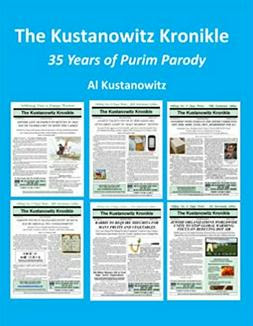
Just Published: The Kustanowitz Kronikle - 35 Years of Purim Parody
Every Purim for the past 35 years we have published a Purim parody edition of The Kustanowitz Kronikle, covering virtually every aspect of Jewish life, and including parodies of hundreds of popular movies. This year we decided to retire the series and capture all the fun in a book that's just been published and is available at Amazon.com. It has every Purim issue of The Kustanowitz Kronikle from 1988 through 2022 in a full-color, full-size paperback book with hilarious headline stories and parody movie picks. Here are a few examples: TRUMP, NETANYAHU SWAP ROLES, COUNTRIES; NEW TALMUD VOLUME "VOTIN" FOUND IN IRAQ; JOINS "FRESSIN", "NAPPIN", TANTZEN","PATCHEN"; "JUDAICARE" PROGRAM PLANNED TO ENSURE THAT ALL JEWS HAVE SYNAGOGUE MEMBERSHIP; RABBIS CREATE TALMUD AMERICANI; NEW LAWS EXTEND HALACHA TO THANKSGIVING AND JULY 4; JEWISH ORGANIZATIONS WORLDWIDE UNITE TO STOP GLOBAL WARMING; FOCUS ON REDUCING HOT AIR; RABBIS TO REQUIRE SHECHITA FOR MANY FRUITS AND VEGETABLES
Jewish Humor Central Staff
Publisher and Editor-in-Chief:
Al Kustanowitz Food and Wine Editor:
Aviva Weinberg Israel Food and Wine Consultant Penina Kustanowitz Reporter and Photographer:
Meyer Berkowitz Reporter Phyllis Flancbaum
"Jewish Traces in Unexpected Places" is now available on Amazon.com in paperback and Kindle editions
This book presents 150 anecdotes and associated video clips that reveal the myriad ways that Jewish culture, religion, humor, music, song, and dance have found expression in parts of the world that, at first glance, might not seem supportive of Jewish Life. It includes 50 videos of Hava Nagila being performed from Texas to Thailand, from India to Iran, and from Buenos Aires to British Columbia. Also highlighted are 34 international versions of Hevenu Shalom Aleichem, Adon Olam, Abanibi, and Tumbalalaika. Whether you’re reading the print version and typing in the video URLs or reading the e-book version and clicking on the links, you’ll have access to 150 video clips totaling more than 10 hours of video. Enjoy!
"Israel is a Funny Country" is now available on Amazon.com in paperback and Kindle editions
This book explores the multifaceted nature of humor in Israel, some of which is intentional and some of which is unintentional. Either way, the quirks of Israeli life contribute to making that life interesting and fulfilling. In the pages of this volume, we take a look at humorous slices of Israeli life, Israeli comedy, satire and parody, funny TV commercials, unusual stories about food, surprising rabbinic bans on daily activities, simchas as they can only be celebrated in Israel, and endearing aspects of Israeli culture. There are more than 120 anecdotes and links to video clips totaling more than six hours of video. We hope that these anecdotes and video clips give you a new and different insight into life in Israel, and encourage you to join in the fun by planning a visit to the land flowing with milk and honey.
Now Open: The Jewish Humor Central Gift Shop
Jewish Humor Central logo merchandise is now available. Click on the image above to see the complete collection -- More than 100 items from tote bags, baseball caps, mugs, aprons, drinkware, T-shirts and sweatshirts, to pajamas and underwear.
The Best of Jewish Humor Central - Now Available in eBook and Paperback at Amazon.com
The Best of Jewish Humor Central - More than 400 video clips, including music and comedy videos for all the Jewish holidays. View them on Your PC, Mac, Kindle Fire, iPad, iPhone, iTouch, Android Tablet and Smartphone. Click on the image above to peek inside and download a free sample. And now, a paperback edition for anyone who prefers a traditional book and doesn't mind typing the URLs instead of clicking on them.
About the Publisher and Editor-in-Chief
A long-term devotee of Jewish humor, Al Kustanowitz has been collecting and sharing it even before there was an internet. In 2009, after a 36-year career at IBM managing new technology projects, he founded Jewish Humor Central (jewishhumorcentral.com. Through the blog he brings a daily dose of fun and positive energy to readers who would otherwise start the day reading news that is often drab, dreary, and depressing (subscribing is free). He has published 12 books on humor based on his more than 4,000 blog postings, each of which includes a video clip and his commentary.
He has presented more than 100 programs in South Florida and the Northeast on topics that include the great comedians and entertainers of the 20th century, funniest moments in film and television, flash mobs around the world, and composers and lyricists of the Great American Songbook.
He earned his bachelor's and master's degrees from the City University of New York and taught computer science courses at the Courant Institute of Mathematical Sciences at New York University. He is a member of the Advisory Board of the International Association of Yiddish Clubs.
You can contact Al via email at akustan@gmail.com.
Daily Reyd
-
Article summaries generated by AI: • Surviving 9/11: Four Jewish New
Yorkers Remember That Day – four Jewish New Yorkers recall surviving 9/11,
including a...
Good News, Bad News
-
Shabbat Shalom!
This was a Dry Bones cartoon from 2018. It is still true today. Even though
Israel has sealed or blown up much of the system, a lot rem...
What is Actually Going on in Qusra?
-
It’s the end of August. Chofesh hagadol is over, thank God, and tomorrow
morning the kids go back to school. In Jerusalem that means moving season
is at ...
Was Benoît Mandelbrot Jewish?
-
Yes, Benoît Mandelbrot was a Jew. The Times obituary says he, "was born on
Nov. 20, 1924, to a Lithuanian Jewish family in Warsaw. In 1936 his family
fled ...
Thoughts on the Haggadah by Rabbi Eli Teitelbaum
-
[image: Story 375601404]
We just recently were able to find the latest version of my fathers, Rabbi
Eli Teitelbaum Z”L, thoughts on the Haggadah and conve...
Hamantaschen: The Symbolism behind Purim Cookies
-
Purim is a celebration of masquerade, Mishloach Manot, Hamantaschen and
book of Esther reading. Every Jewish holiday focuses on a special dish and
the tria...
Thank you for your support!
-
Thank you very much for supporting our work at The Muqata. We appreciate
your contribution and hope to be able to keep bringing you the most up to
date ...
Boarding School Massachusetts
-
Every fall the Massachusetts Health Connector provides information
concerning the public higher education institutions and designed to prevent
offenders ...
A chat with some protesters…
-
Originally posted on don of all trades:
Hi protesters, it’s me, Don. Do you remember me? No? I’m a police officer.
We’ve met before. Excuse me? Did you say...
Jerusalem Walking Tours for Sukkot
-
It is about time that I brought back my “Jerusalem: Meet Jerusalem” walking
tour series. And while I am nearing completion on a few new ones that I
hope to...
Trayf of the Week: Bacon Jam
-
Just when you thought it was safe to eat your bagels in mixed company,
comes this devilish concoction. Next time a Goyishe friend offers you a
shmear, mak...




 Posts
Posts